
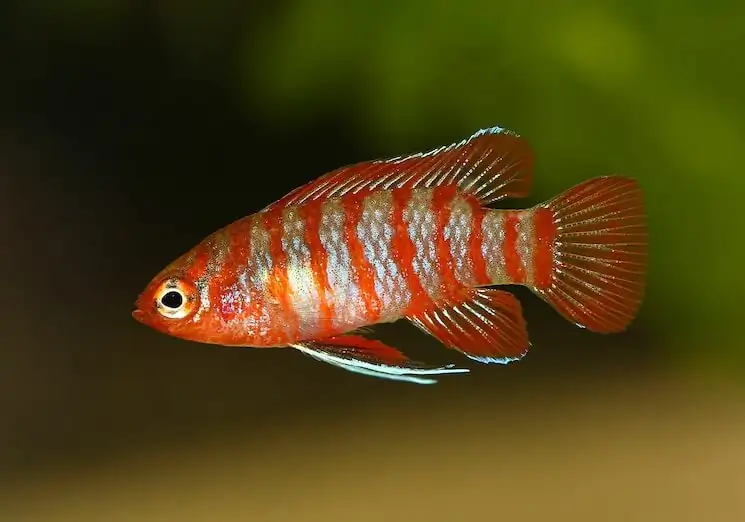
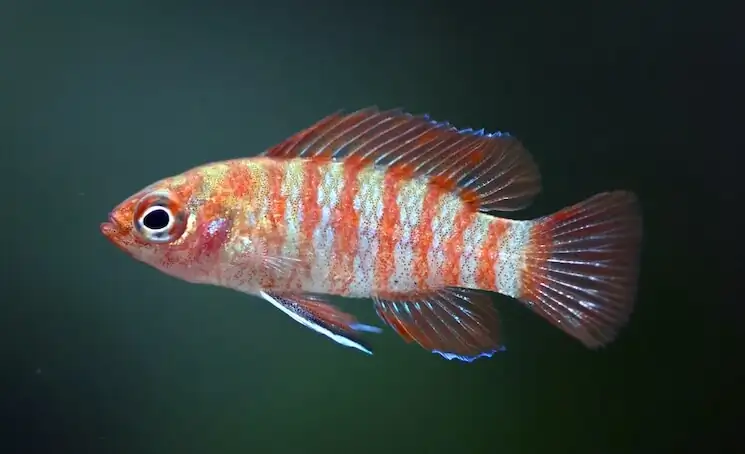
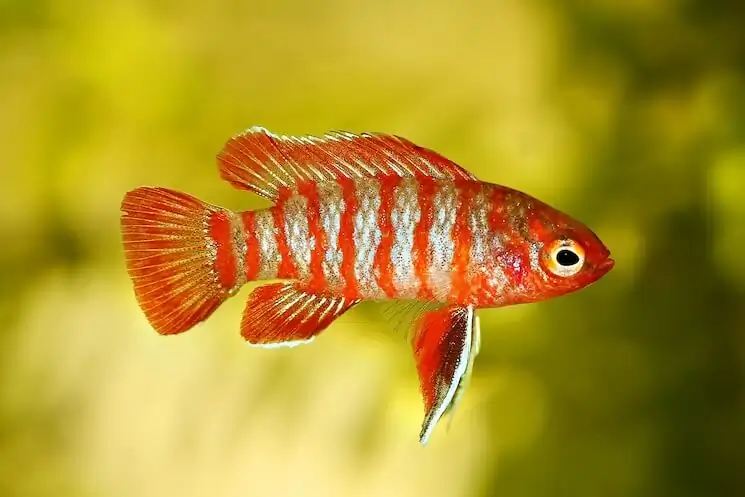
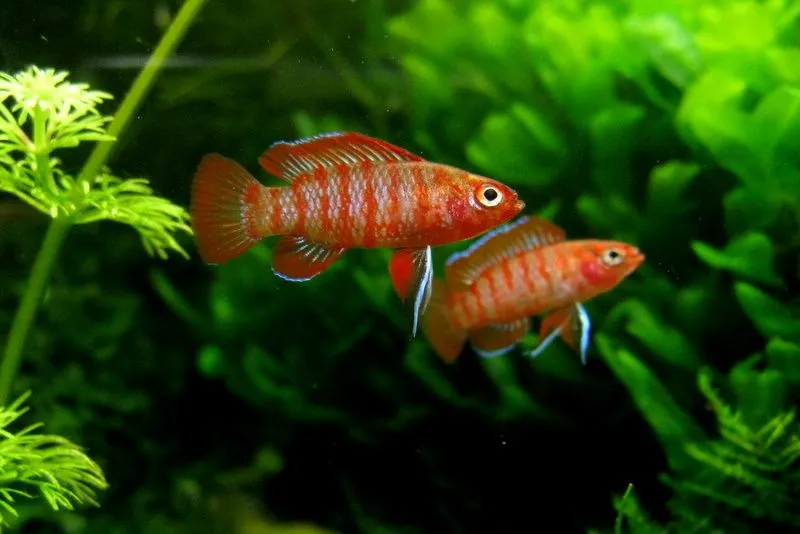
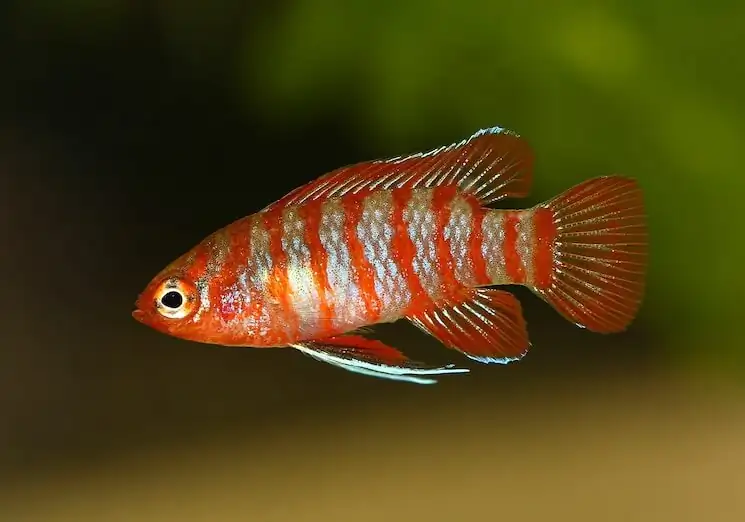
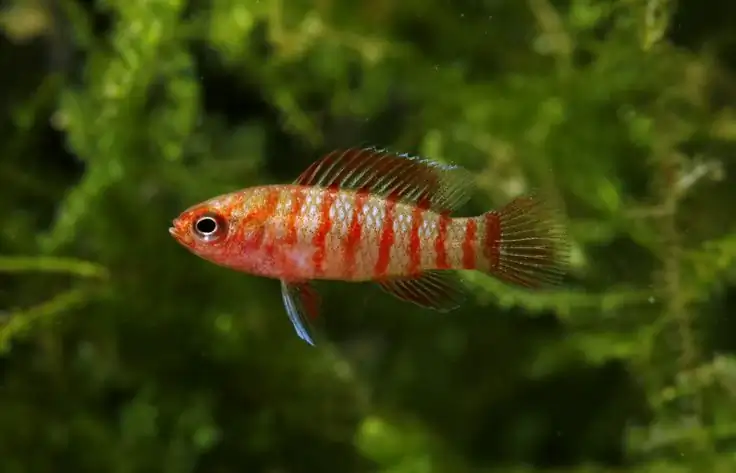
Males feature 7 dark vertical bars across sides with bold red coloration, while females exhibit uniform grayish coloration or indistinct vertical bars. Breathtaking coloration and activity peaks during spawning, with rival males "facing off" or "dancing" alone for a female's attention.
The typical biotope for the Scarlet Gem Badis is clear, slow-moving streams with marginal vegetation. In the home aquarium, the Scarlet Gem Badis prefers densely planted aquariums with sandy substrate or fine gravel and plenty of surface vegetation as well. Also provide bogwood for hiding spots.
Not a candidate for the community aquarium, the shy Scarlet Gem Badis is best kept in species-only aquariums or alongside small anabantoids such as Liquorice Gouramis. Success has also been noted keeping with small shoals of Dwarf Spotted Rasboras, as long as you ensure enough food reaches your Scarlet Gem Badis.
Diet should consist of small live and frozen foods like bloodworm, daphnia, Cyclops and microworms. The Scarlet Gem Badis is a finicky eater, so observe carefully to ensure that what you offer is being eaten - and adjust diet accordingly.
Origin and Distribution
The scarlet badis originates from the fresh waters of India. They like to live among dense vegetation in the tributaries of the rivers. They have limited distribution and are not easily collected from the wild. They are bred in captivity, however, so buying wild-caught fish is not necessary.
Colors and Markings
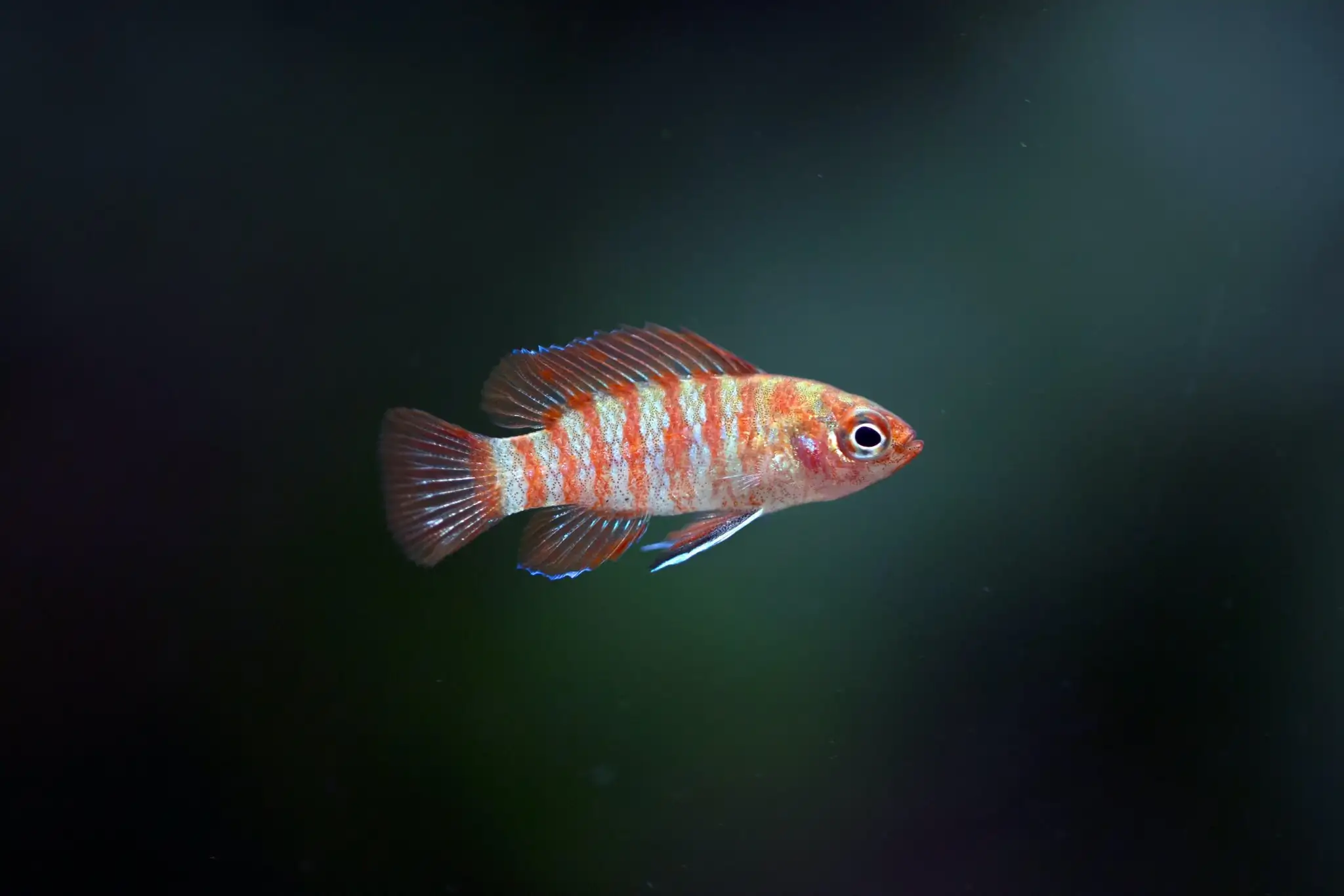
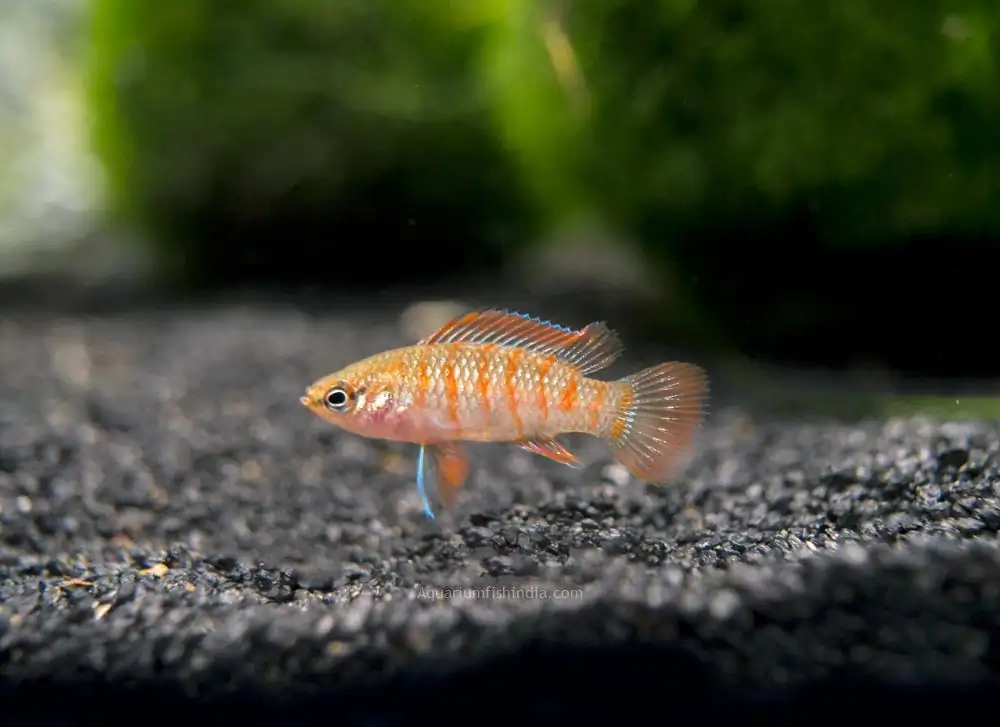
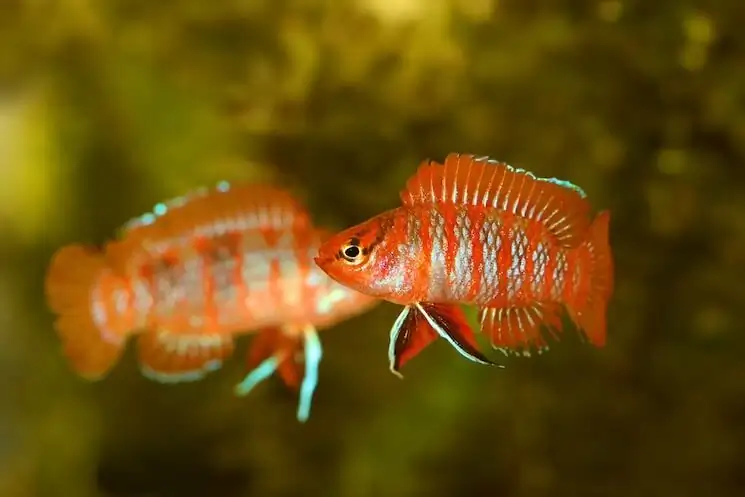
The scarlet badis is prized for their vivid coloration. The males' bodies are primarily red to orange with lighter colored bars along their entire sides. The lighter color lines can be light yellow to silvery-blue. Females have more muted colors and appear more gray all over, and the juveniles look identical between males and females. When spawning, the males get their brightest colors and “dance” for a female’s attention.
In the genus Dario there are 6 species (4 of which are classed as miniature species):
- Scarlet Badis (Dario dario): Males are bright orange/vibrant red with 7 pale silvery-blue vertical bands beginning from the start of the dorsal fin, continuing onto the fins. As they mature their pelvic, dorsal and anal fins are highlighted in blue. There are 8½ scales present in the transverse row and distinct lines on the supraorbital region.
- Dario dayingensis: These males have the same bright orange color as the Scarlet Badis, however they have no blue highlighting. In comparison to Scarlet Badis, this species has palatine teeth and 9 ½ scales in the transverse row.
- Dario hysginon: The most obvious difference between this species and Scarlet Badis is the color pattern between males. This species has a black spot on the front of their dorsal fin.
Tankmates
Since this fish is very small, they are easily intimidated by larger fish. This makes them an unsuitable choice for most freshwater community aquariums, unless the number of species is limited and the other species are also small fish. If possible, the scarlet badis will do best in a species-only tank, full of vegetation and hiding places.
Scarlet Badis Habitat and Care
Given their small size, special consideration should be taken to provide the scarlet badis with an appropriate habitat. Small fish feel safe when they have hiding spaces. To mimic their natural habitat, a heavily planted aquarium is recommended as a home for the scarlet badis. This will allow all the fish to have adequate cover and places to feel safe. You can also recreate this with artificial plants and other décor items—just ensure adequate water flows through the various components so the tank water is aerated.
As with all aquariums, you must test the water chemistry regularly and stick to a regular maintenance routine. For planted tanks, you must regularly trim back any dead leaves and aerate the roots. You will likely have to supplement your live plants with a fish-safe aquatic fertilizer.
The Scarlet Badis is very sensitive to changes in water conditions.
Bad water quality will stress your fish and make it more likely for them to develop diseases. You will need to pay attention to the water condition and measure it weekly.
Fortunately there are no known diseases that specifically target this species.
However they can become susceptible to disease if overfed. They are very susceptible to obesity which can lead to illness. It is best to avoid or rarely feed them bloodworms and Tubifex worms, as these are a very meaty addition to their diet.
Like other freshwater fish they can be prone to Ich and any other bacterial and fungal diseases. However if the water quality is kept within the correct parameters it is unlikely.
One thing that is commonly noticed is the appearance of black/dark brown spots. These spots can be simple coloration or can appear due to ammonia burn when nitrates are too high.
These spots appear orange or red, however they can be difficult to see on the body of Scarlet Badis because of their orange body color.
Make sure you keep an eye on nitrate levels.
Scarlet Badis Diet and Feeding
The scarlet badis is an omnivore with a taste for crunchy, meaty treats. If you have any snails roaming around your tank and they reproduce, the scarlet badis will like to snack on the baby snails. However, this may not necessarily be a bad thing for your tank and will prevent it from becoming overrun by snails.
Pay attention to the size of the food you are feeding to these small fish. Most tropical fish granule pellets are appropriately sized for small fish, but you may need to start with a flake diet in order to have particles small enough for the scarlet badis. Once your fish is able to eat a pelleted diet, it is best to stick with this since it will not foul your water as much, as pellets dissolve much slower than flakes.
You are welcome to feed your scarlet badis a mix of pellets, flakes, small pieces of veggies, and frozen treats. Small live or freeze-dried foods like bloodworms, microworms, daphnia, or cyclops can be fed occasionally, especially when trying to induce spawning. The scarlet badis is a finicky eater, so watch that what you offer is being eaten.
Watch your fish carefully when they eat because it is very easy to overfeed a small fish. Feed them at least twice a day in very small amounts. Feeding too much food will be wasted and can cause an ammonia spike or other issues with your nitrogen cycle. Since they are shyer fish, be sure that any other fish in their tank do not steal all the food before your scarlet badis feel confident enough to come out to eat.
Gender Differences
When they are small and developing, you cannot tell the differences between male and female scarlet badis. As they mature, males will become more vibrantly colored and larger, whereas the females will tend to stay smaller with more muted colors.
Breeding the Scarlet Badis
Once you have a male and female, they should be separated in a breeding tank with no other fish and lots of appropriate décor of artificial or live plants. They will need to be fed a higher fat and protein diet than their typical maintenance food in order to develop mature gonads. Try to eliminate all other stressors in their environment such as poor water quality, loud noises, or sudden movement.
You will note the male furiously swimming around the female in order to entice her to lay her eggs. When she is ready, the female scarlet badis will lay her eggs on the underside of a leaf, which is why it is critical to have plants in their breeding tank. The male will then swim behind her to fertilize the eggs.
Once the eggs are laid, the parents can be moved back to their original tank. The eggs will hatch in a few days with a prominent yolk sac attached to the larvae. Once this has been absorbed, you will need to start feeding the fry a high fat and protein diet in order to encourage proper development. Starter fry food is available commercially at fish dealers or online. Newly hatched brine shrimp can also be fed to the fry. As with most fish reproductive strategies, they will lay many eggs and only a handful will survive to maturity.




Leave your comments