It’s time to help contribute for biggest aquarium gallery online

SUBMIT HEREVIEW GALLERY

Betta splendens (Orange Betta Male)

Overview

The Orange Betta Male is a breathtaking color morph of the traditional Betta fish, scientifically known as Betta splendens. Highly sought after for their brilliant, sunset-like hues, these fish are a favorite among both novice and experienced aquarists. Like all bettas, they possess a unique labyrinth organ that allows them to breathe atmospheric air, a vital adaptation from their natural environment.

Distribution and Habitat

Wild Bettas are native to the Mekong basin of Southeast Asia, specifically localized in countries like Thailand, Cambodia, and Vietnam. They naturally inhabit shallow, sluggish, or standing waters, including rice paddies, swamps, slow-moving streams, and drainage ditches. These environments are typically densely vegetated and have low oxygen levels, which is why the labyrinth organ is so crucial for their survival.

Image of Orange Betta Male

Description of Orange Betta Male

The Orange Betta Male is renowned for its intense, warm coloration and dramatic finnage. Through years of selective breeding, aquarists have developed various fin types, but the striking orange hue remains the standout feature of this specific morph.

Body shape:

They possess a streamlined, torpedo-shaped body that is slightly laterally compressed, allowing them to navigate smoothly through dense vegetation.

Color:

The body and fins are draped in a vivid, fiery orange. Depending on the lighting and genetics, this can range from a soft tangerine to a deep, vibrant neon orange.

Barbels:

Betta fish do not possess barbels.

Snout:

They have an upturned mouth (superior mouth), which is perfectly adapted for their top-dwelling nature and surface-feeding habits.

Eyes:

Their eyes are dark, prominent, and highly perceptive, allowing them to easily spot prey and potential rivals.

Fins:

Male Bettas are famous for their elongated, flowing fins. The dorsal, anal, and pelvic fins are dramatically extended and often display a beautiful, sail-like appearance when the fish flares.

The Tail:

The caudal (tail) fin is broad and flowing. Depending on the specific tail type (such as Halfmoon, Veiltail, or Plakat), the tail can form a massive semi-circle of solid orange, adding to the fish's majestic presence.
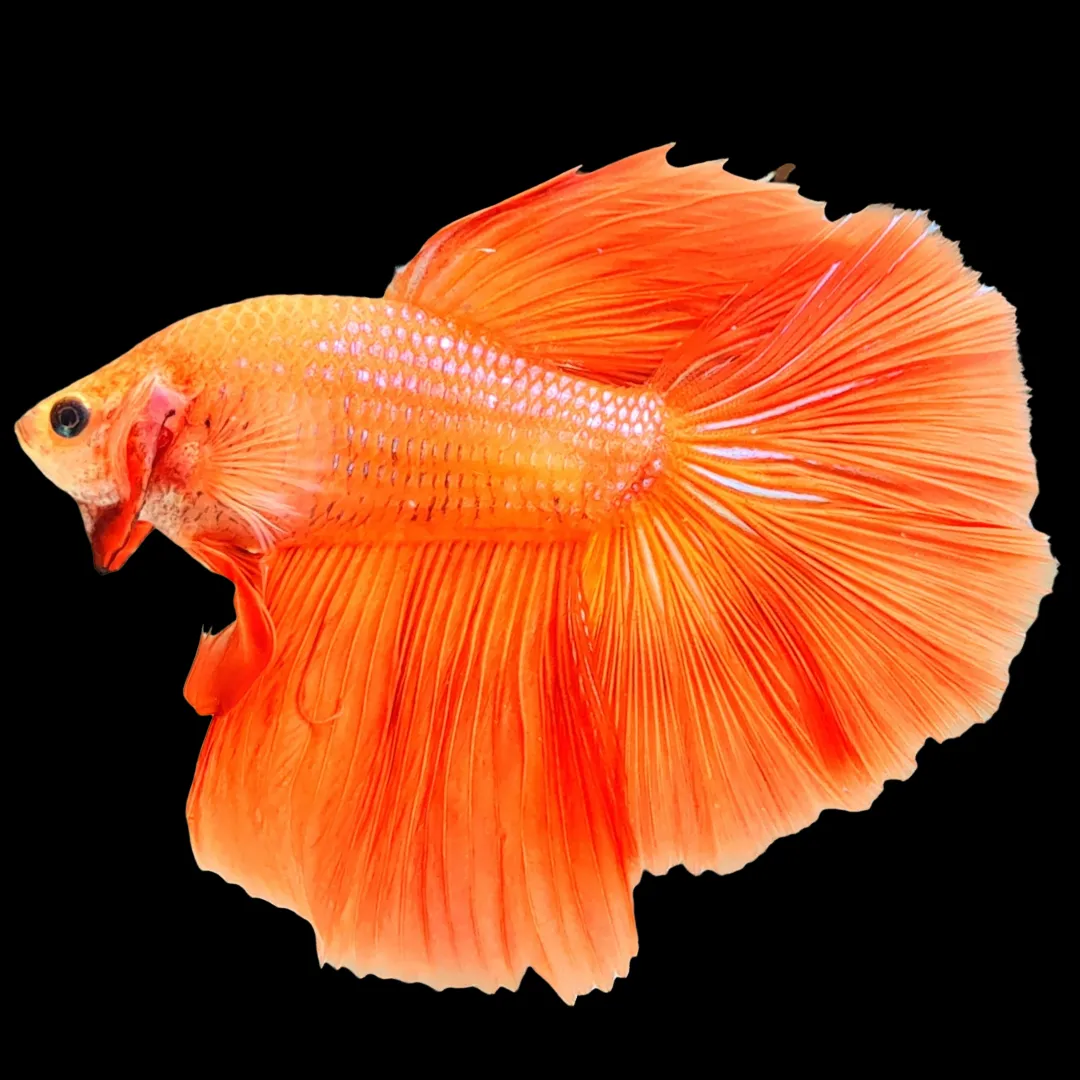
Image of Orange Betta Male

Temper

Male Bettas are famously aggressive and highly territorial, especially towards other male bettas or fish with similar flowing fins and bright colors. They will flare their gills and fins to appear larger when threatened or establishing dominance.

Sociality

Because of their aggressive nature, two male bettas must never be housed together. They are best kept as solitary centerpieces in smaller tanks. In larger community setups, they can be kept with peaceful, dull-colored, short-finned, bottom-dwelling fish (like Corydoras or small tetras), provided there is ample space and hiding spots.

Activity

Orange Betta Males are diurnal and moderately active. They spend much of their time patrolling their territory, resting on broad leaves near the surface, and investigating their surroundings.

Keeping and Caring for Orange Betta Male

Despite their hardy reputation, Bettas require specific care to thrive and display their best colors. Proper tank setup and pristine water conditions are essential to prevent fin rot and other common diseases.

Tank size:

A minimum tank size of 19 liters (5 gallons) is highly recommended for a single male. Smaller bowls are inappropriate and detrimental to their health.

Water Parameters:

Maintaining stable water conditions is crucial for the health and longevity of your Orange Betta.

Temperature

They are tropical fish and require a heated aquarium. Keep the water temperature consistently between 24-28°C (75-82°F).

pH

Aim for a slightly acidic to neutral pH level, ideally between 6.5 and 7.5.

Hardness

They prefer soft to moderately hard water, generally between 3 and 4 dGH.

Ammonia, Nitrite, Nitrate

Ammonia and Nitrite must always be at 0 ppm. Nitrates should be kept below 20 ppm through regular water changes.

Lighting

Provide low to moderate lighting. Bettas do not like overly bright environments, and subdued lighting helps mimic their natural shaded habitats.

Water flow

Water flow must be kept to an absolute minimum. Their long, heavy fins make it difficult for them to swim in strong currents, which can cause severe stress and exhaustion.
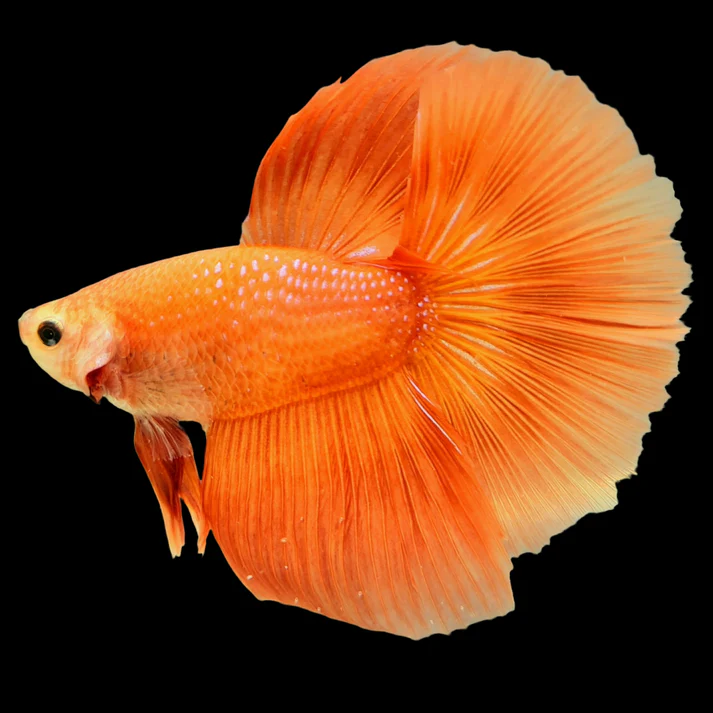
Image of Orange Betta Male

Decorations and Plants

Live plants such as Anubias, Java Fern, and floating plants are highly recommended as they provide resting spots near the surface. Avoid decorations with sharp edges or rough plastic plants, as these can easily tear their delicate fins. Smooth caves or driftwood offer great hiding places.

Diet

Bettas are strict carnivores. In the wild, they feed on insects and larvae. In captivity, their diet should consist of high-quality betta pellets, supplemented with protein-rich treats like freeze-dried or frozen bloodworms, brine shrimp, and daphnia.

Some Feeding Tips

Feed them small amounts once or twice a day—only what they can consume in a couple of minutes. Bettas are prone to bloating and constipation, so it is crucial not to overfeed them. Fasting them for one day a week can help clear their digestive tract.

Breeding

Breeding Bettas is a fascinating but complex process that requires a separate breeding tank. Males are bubble nesters; they build a nest of bubbles at the water's surface. Once a female is introduced and accepted, the male will wrap his body around hers to fertilize the eggs as they drop. The male then meticulously collects the eggs, places them in the bubble nest, and aggressively guards them until they hatch, at which point the female must be removed.

Conclusion

The Orange Betta Male is an exceptionally beautiful and rewarding fish to keep. With their fiery colors and engaging personalities, they make a stunning addition to any appropriately sized and well-maintained aquarium. By providing them with warm, clean water, a high-protein diet, and a stress-free environment, aquarists can enjoy the vibrant company of these magnificent fish for years to come.

Fish info

Care level: Easy
Temperament: Aggressive
Adult size: 5-7 cm
Life expectancy: 3-5 years
Fish type: Labyrinth Fish
Temperature : 24-28°C
pH: 6.5-7.5
Color Form: Orange
Leave your comments
Lastest on Fishs
  • Channa andrao (Blue Snakehead)

    Moderate
    Labyrinth Fish
    The Blue Snakehead (Channa andrao) is a captivating dwarf species highly sought after by aquarium enthusiasts. Originating from the swamps of India, this rare gem boasts mesmerizing blue hues and fascinating behaviors. Despite its predatory nature, its manageable size makes it an incredible centerpiece for dedicated keepers.
  • Moenkhausia sp. (Blue-Eye Kogal Tetra)

    Easy - Moderate
    Labyrinth Fish
    The Blue-Eye Kogal Tetra, an undescribed Moenkhausia species, is a stunning and active schooling fish prized for its striking bright blue eyes and shimmering golden-silver body. Originating from South America, this peaceful yet energetic tetra adds a captivating gleam and dynamic movement to any well-planted community aquarium.
  • Carnegiella marthae (Blackwing Hatchetfish)

    Moderate
    Labyrinth Fish
    The Blackwing Hatchetfish is a fascinating, peaceful surface-dweller native to the slow-moving, acidic waters of South America. Known for its uniquely deep, keeled belly and remarkable ability to leap from the water to catch insects, this distinctive schooling fish adds captivating upper-level activity to any well-covered community aquarium.
  • Hyphessobrycon wadai (Blackberry Tetra)

    Easy - Moderate
    Labyrinth Fish
    Hailing from the clear waters of Brazil's Rio Tapajós basin, the Blackberry Tetra (Hyphessobrycon wadai) is a stunning, recently described species. Known for its striking deep purple-blue coloration and peaceful schooling nature, it has quickly become a highly sought-after gem among aquarists looking to add vibrant contrast to planted aquariums.
  • Megalamphodus megalopterus (Black Phantom Tetra)

    Easy
    Labyrinth Fish
    The Black Phantom Tetra, native to the Guaporé and Paraguay river basins, is a striking and peaceful schooling fish. Known for its elegant, contrasting black and silver appearance and elongated fins in males, it is a highly popular and hardy choice for planted community aquariums.
  • Hyphessobrycon herbertaxelrodi (Black Neon Tetra)

    Easy
    Labyrinth Fish
    Originating from the Paraguay basin in South America, the Black Neon Tetra is a peaceful, schooling fish beloved by aquarists. Known for its striking black and iridescent greenish-white lateral stripes, this hardy species adds vibrant contrast and active, dynamic movement to any well-planted community aquarium.
  • Nematobrycon palmeri (Black Emperor Tetra)

    Easy - Moderate
    Labyrinth Fish
    The Black Emperor Tetra is a striking, captive-bred melanistic variety of the classic Emperor Tetra. Originating from Colombian lineages, this peaceful, active fish is highly prized in the aquarium hobby for its deep, velvety black coloration and iridescent purple sheen, adding dramatic elegance to any planted community tank.
  • Puntius titteya (Albino Fire Red Cherry Barb)

    Easy
    Labyrinth Fish
    The Albino Fire Red Cherry Barb is a stunning, selectively bred variation of the classic Cherry Barb. Originating from Sri Lanka's shaded streams, this peaceful cyprinid boasts vibrant red-orange hues and striking red eyes. Its hardy nature and active schooling behavior make it highly popular among freshwater aquarists.
  • Puntius titteya (Cherry Barb)

    Easy
    Labyrinth Fish
    Native to the shaded streams of Sri Lanka, the Cherry Barb (Puntius titteya) is a remarkably peaceful and hardy schooling fish. Renowned for the male's vibrant, deep red breeding coloration, this active cyprinid is a highly popular, easy-to-care-for addition to heavily planted community aquariums worldwide.
  • Channa pulchra (Peacock Snakehead)

    Moderate
    Labyrinth Fish
    Native to the fast-flowing streams of Myanmar, the Peacock Snakehead (Channa pulchra) is a stunning, subtropical species highly prized by aquarists. Known for its vibrant blue hues, striking black spots, and relatively peaceful demeanor for a snakehead, it makes a captivating and hardy addition to specialized predator setups.
  • Sawbwa resplendens (Sawbwa Barb)

    Moderate
    Labyrinth Fish
    Endemic to Lake Inle in Myanmar, the Sawbwa Barb (or Asian Rummynose) is a striking, completely scaleless micro-cyprinid. Males boast a bright red head and tail tips against a silvery-blue body. Their peaceful schooling nature and unique appearance make them highly sought after by nano aquarium enthusiasts.
  • Channa bangkanensis (Bangka Snakehead)

    Moderate - Difficult
    Labyrinth Fish
    The Bangka Snakehead (Channa bangkanensis) is a captivating, medium-sized predator native to the blackwater peat swamps of Southeast Asia. Known for its striking reddish-brown coloration and aggressive ambush behavior, this species is highly sought after by experienced aquarists looking for a unique, specialized, and interactive predatory fish.
  • Ambystoma mexicanum (White Axolotl)

    Moderate
    Labyrinth Fish
    The White Axolotl, a captivating morph of Ambystoma mexicanum, is a fully aquatic salamander renowned for its neotenic traits and regenerative abilities. Originating from Mexico's high-altitude lakes, this captive-bred marvel has become incredibly popular in the aquarium hobby thanks to its unique, smiling appearance and fascinating, completely aquatic lifestyle.
  • Ambystoma mexicanum (Albino Axolotl)

    Moderate
    Labyrinth Fish
    The Albino Axolotl is a captivating, fully aquatic salamander native to the ancient lake systems of Mexico. Renowned for its extraordinary regenerative abilities and perpetual larval stage, this peaceful amphibian is highly popular among aquarists for its unique appearance, striking feathery gills, and endearing, permanent smile.
  • Sundadanio axelrodi (Blue Sundadanio)

    Moderate - Difficult
    Labyrinth Fish
    The Blue Sundadanio, scientifically known as Sundadanio axelrodi, is a stunning, miniature cyprinid native to the blackwater peat swamps of Southeast Asia. Known for its iridescent blue coloration and peaceful demeanor, it is a highly sought-after nano fish for advanced aquarists looking to create a specialized biotope aquarium.
  • Chelonodon patoca (Milk Spotted Puffer)

    Moderate - Difficult
    Labyrinth Fish
    The Milk Spotted Puffer, also known as the Asian Parrot Puffer, is a fascinating but demanding species originating from the Indo-West Pacific. Known for its distinct white spots and highly intelligent behavior, it transitions from freshwater to brackish or marine environments as it matures, making it a unique challenge for dedicated aquarists.